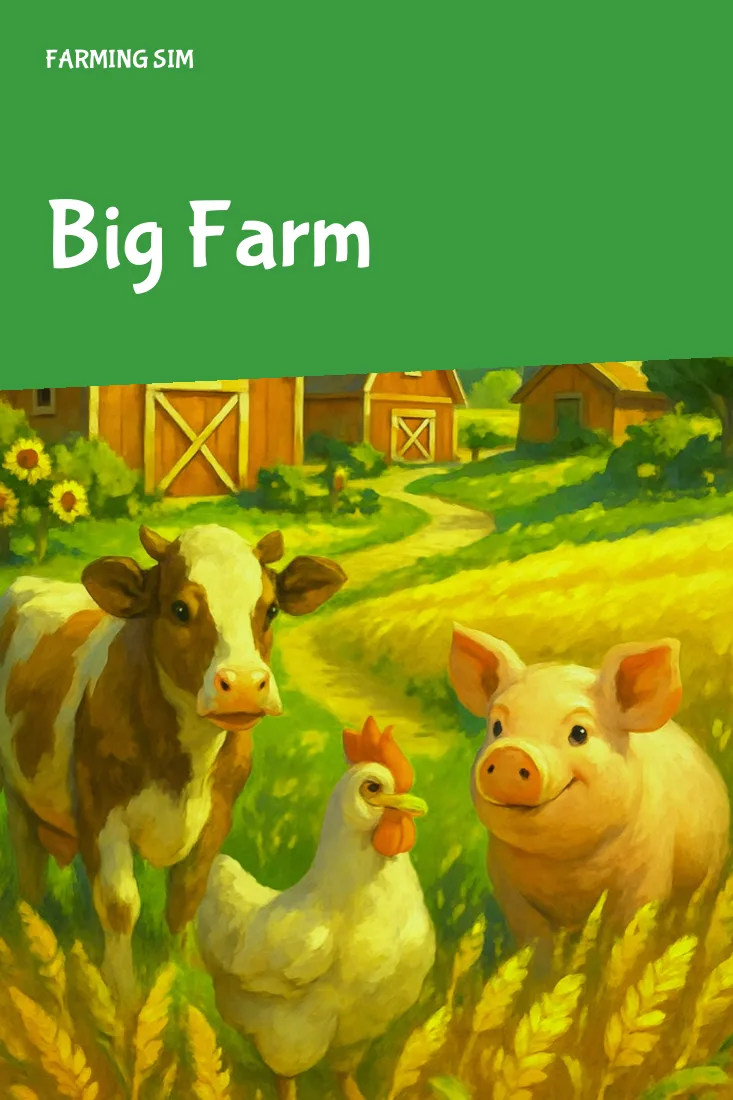
Big Farm comes from Goodgame Studios in Hamburg and has been running in browsers since 2012. On the surface it is a familiar farm: plant fields, raise chickens, cows and pigs, upgrade buildings and sell what you produce on the market. It is bright and cheerful, the opening hours move briskly, and within a few evenings you have a farm that looks busy and prosperous. Taken purely as a solo game, it is perfectly decent, and not much more.
What sets it apart is the cooperative. Goodgame describes an exclusive cooperative and research system, and in practice that system becomes the reason to stay. Teams research upgrades together, coordinate during events and push toward shared goals. We joined a cooperative in our first week and spent the following six weeks discovering that Big Farm is really a team game wearing a solo farm’s clothes.
Fields, barns and a steady production cycle
The core loop is clean and readable. Crops grow on realistic production cycles, animals need feeding, and their products feed into further buildings. Goodgame counts more than forty-five buildings and upgrade levels and more than ninety products, which gives the economy a reasonable breadth. Upgrading a building is usually the right call, and the game makes it easy to see where your bottlenecks lie at any given moment.
It is less demanding than My Free Farm, though. Chains are shorter, and the best move is often obvious, which is why our economy score sits at seven rather than nine. That is not entirely a criticism. Big Farm wants you thinking about your team as much as your own fields, and a simpler economy leaves room for that. Solo planners chasing a puzzle, however, will reach the edges of it sooner.
The cooperative is the real game
Inside a cooperative, Big Farm changes character. Members contribute to research that benefits everybody, coordinate during events and compete as a group against other farms. Suddenly your production has a purpose beyond your own coin balance. We found ourselves planting specific crops because the team needed them that week, and logging in on a weekday morning to cover a gap left by a teammate in Halifax who was on a night shift.
That sense of obligation cuts both ways. A good cooperative is warm, organized and motivating. A disorganized one can feel like an unpaid job with a group chat attached. Our advice is to sample a few before settling, and to look for one whose expectations match your week. The best teams we saw were explicit about how much they asked of members, and they were happy to welcome casual players.
Events, missions and farms on faraway islands
Events give Big Farm its pulse. Goodgame frames them as challenges and missions with their own goals, and they arrive often enough that there is usually something under way. Some run for a few days, others for weeks. They are the busiest part of the game, and the part where cooperatives matter most, because team contributions add up quickly and the shared rewards are noticeably better than anything you would earn alone.
There are also extra farms to unlock as you level, including island farms with a Caribbean flavour, plus the option to build your own rather wacky farm machines. These additions refresh the scenery and give long-time players a new set of fields to organize. We enjoyed the islands in particular; they feel like a holiday from the home farm without abandoning the systems you have already learned to manage.
Where the pace starts to pinch
Our lowest score for Big Farm is pacing. The event calendar is busy, and a cooperative pushing for a strong finish can make several visits a day feel expected rather than optional. Timers are reasonable, but the overall rhythm leans toward frequent check-ins, especially around events. Players with irregular schedules may find that a little stressful, and it is worth knowing before you promise a team your time.
Layout freedom is modest too. There are more than a hundred decorations, and you can make the farm look tidy and personal, but the grid of production buildings dominates the view. Note also that the browser game reviewed here runs on desktop only. Goodgame’s mobile farm, Big Farm: Mobile Harvest, is a separate title with its own farm, not a companion app to this one, so plan accordingly.
Your opening week in Big Farm
- Follow the early quests to unlock core buildings quickly; they move faster than most farm openings.
- Upgrade existing buildings before adding new ones, since upgrades usually remove the tightest bottlenecks.
- Sell surplus on the market regularly instead of hoarding, to keep coins flowing into upgrades.
- Try two or three cooperatives before committing, and ask each how many visits they expect weekly.
- Take part in your first event with your team to see how shared contributions really work.
What wears thin
- Event pressure can make frequent visits feel expected rather than chosen
- Production chains are shorter and simpler than the best farms on our list
- No companion app; the mobile Big Farm is a separate game entirely
What keeps us coming back
- A cooperative and research system that gives every harvest a team purpose
- Frequent events and missions that keep the calendar lively for social players
- Island farms and extra estates that refresh the scenery in later levels
- Bright, readable presentation that makes the opening hours feel welcoming
Who will settle happily into Big Farm
Sociable farmers who want teammates, shared targets and a lively event calendar, and who can check in several times a day. Solo players and those with unpredictable schedules will find calmer, deeper farms elsewhere in our six.
Where we land on Big Farm
Big Farm is a solid, friendly farm that becomes something better inside a good cooperative. The team research and events give it a social energy no other game here quite matches. Its economy is simpler than our top farms, its pace can pinch, and it lives on the desktop only. Join the right team, though, and it can easily become a long-term habit.